






CONTACT US

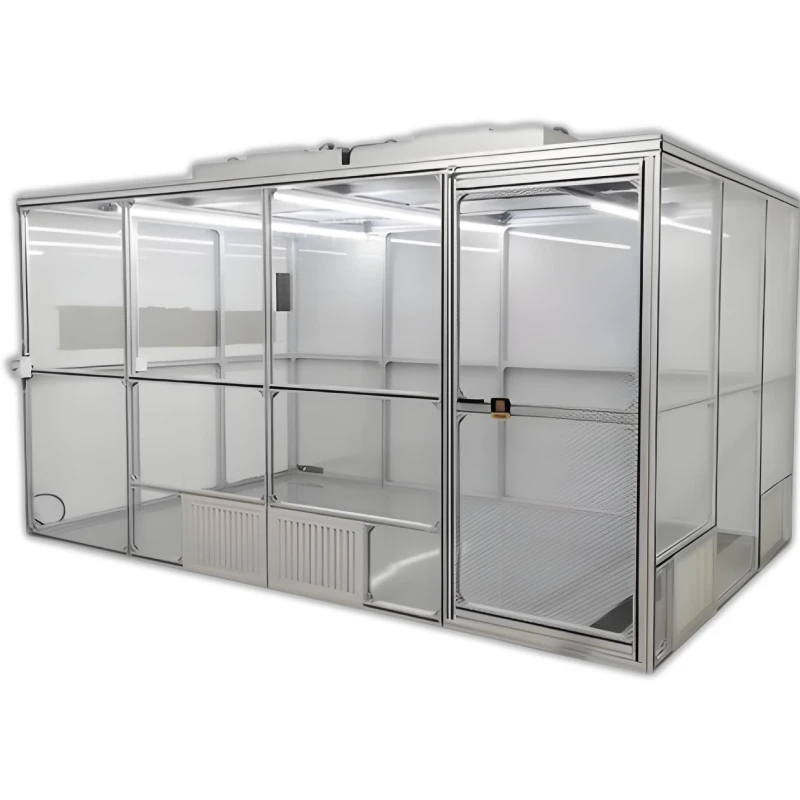
Acrylic Clean Booth / Acrylic Clean Enclosure
Overview:
The Acrylic Clean Booth is a modular, self-supporting contamination control enclosure designed to create a local clean zone within a general workshop or existing cleanroom. Constructed with transparent acrylic panels and an industrial-grade frame, it provides excellent visibility, easy access, and reliable particle protection for sensitive processes. This unit is ideal for applications requiring ISO Class 6–7 (Class 1,000–10,000) cleanliness without the cost of building a permanent cleanroom.
Hot Tags:
DETAIL:
Product Overview
The Acrylic Clean Booth is a modular, self-supporting contamination control enclosure designed to create a local clean zone within a general workshop or existing cleanroom. Constructed with transparent acrylic panels and an industrial-grade frame, it provides excellent visibility, easy access, and reliable particle protection for sensitive processes.
This unit is ideal for applications requiring ISO Class 6–7 (Class 1,000–10,000) cleanliness without the cost of building a permanent cleanroom.
Key Features
-
High Transparency
Optical-grade acrylic (PMMA) panels provide crystal-clear visibility, allowing operators and supervisors to monitor processes from outside without compromising cleanliness. -
Modular Construction
Prefabricated panels and frame components allow for easy assembly, disassembly, and reconfiguration as production needs change. -
HEPA/ULPA Filtration
Integrated fan filter units (FFUs) deliver ISO Class 5–6 clean air vertically downward, sweeping particles away from the work zone. -
Rigid Frame Options
Available with industrial aluminum extrusion (lightweight, corrosion-resistant) or stainless steel (heavy-duty, pharmaceutical-grade) frames. -
Soft or Hard Wall Configurations
Combine acrylic panels with anti-static PVC strip curtains for entry points or partial enclosures, balancing cleanliness with accessibility. -
Static Control (Optional)
Anti-static acrylic panels and grounding kits available for ESD-sensitive electronics assembly. -
Easy Access
Sliding or hinged acrylic doors with magnetic catches or latches provide convenient operator entry.
Optional Accessories
-
ESD Grounding Kit – For anti-static acrylic panels to dissipate static charge.
-
UV Germicidal Lamp – Surface sterilization during idle periods.
-
HEPA Filter Pressure Gauge – Real-time filter differential pressure monitoring.
-
Voice Prompt System – Audio guidance for FFU status and filter replacement alerts.
-
Castors with Brakes – Mobile clean booth for flexible workstation positioning.
-
Stainless Steel Workbench – Integrated table surface inside the booth.
-
Particle Counter Port – Pre-installed port for external particle monitoring.
-
Interlocked Entry Door – Prevents both doors from opening simultaneously.
Applications
-
Electronics Assembly – PCB soldering, mobile phone repair, hard drive assembly.
-
Medical Device Manufacturing – Catheter, syringe, and implant assembly.
-
Laboratory Workstations – Microscope work, sample preparation, cell culture handling.
-
Pharmaceutical Compounding – Non-sterile mixing and dispensing (ISO Class 7–8).
-
Optics & Precision Instruments – Lens assembly, calibration, and inspection.
-
Food Packaging – Hygiene zones for ready-to-eat meal assembly.
-
Research & Development – Clean testing environments for prototype development.
Why Choose an Acrylic Clean Booth?
-
Cost-Effective – Significantly lower capital cost compared to permanent softwall or hardwall cleanrooms.
-
Excellent Visibility – Clear acrylic allows 24/7 visual monitoring without entering the clean zone.
-
Flexible & Expandable – Modular design permits future size changes, relocation, or reconfiguration.
-
Quick Installation – Prefabricated panels assemble on-site in 1–2 days (vs. weeks for traditional cleanrooms).
-
Easy to Clean – Smooth acrylic surface wipes clean with standard cleanroom wipes and isopropyl alcohol.
-
Low Maintenance – FFUs have long-life HEPA filters (3–5 years typical); acrylic panels require no special care.
-
Energy Efficient – Enclosed volume reduces FFU runtime and cooling/heating costs compared to full-room cleanrooms.
FAQ
- 1 What common operational mistakes should be avoided to extend the life of a Clean Room Booth and ensure compliance?
- 2 What do "as built", "at rest", and "operational" mean when performing cleanliness testing?
- 3 What are the daily operation and maintenance points to ensure long term stable operation of a Clean Room Booth?
- 4 What are the daily operation and maintenance points to ensure long term stable operation of a Clean Room Booth?
- 5 Is temperature and humidity control required inside a Clean Room Booth? What are the standards?
- 6 What structural material considerations should be kept in mind when selecting and installing a Clean Room Booth?
- 7 What are "laminar flow" and "turbulent flow"? Why do clean booths mostly use "vertical unidirectional laminar flow"?
- 8 What roles do "FFU" and "HEPA" play in a Clean Room Booth?
- 9 What specific requirements apply when using Clean Room Booths in electronics manufacturing or biopharmaceutical fields?
- 10 What are the core technical standards for a Clean Room Booth? How is its cleanliness class defined?
- 11 What is a Clean Room Booth? How does it differ from a traditional cleanroom?
- 12 What cleanliness levels can booths achieve?
- 13 What is a cleanroom booth?
- 14 Which enclosure materials suit static-sensitive environments?
- 15 What are the benefits of using an Acrylic Clean Booth?
- 16 What distinguishes a Clean Panel Clean Booth from standard models?
- 17 How to choose materials for localized protection structures?
1
What common operational mistakes should be avoided to extend the life of a Clean Room Booth and ensure compliance?
- Airflow obstruction: Do not place tall equipment within 30 cm of the air outlet face, as this directly disrupts laminar flow, causing local eddies and particle accumulation.
- Improper entry: Personnel must wear cleanroom garments, hair covers, and shoe covers, and avoid rapid movements or shaking inside the booth – people are the source of about 80% of contamination in a clean booth.
- Operating with faults: If an FFU fan makes abnormal noise or differential pressure is unusual, stop and inspect immediately. Operating with fan issues can cause HEPA filter media damage and backflow of contaminants into the production area.
2
What do "as built", "at rest", and "operational" mean when performing cleanliness testing?
These three terms define the facility state during testing (per ISO 14644 and GB 50073):
- As‑built: The booth is completed and running, but no production equipment, materials, or personnel are inside. This is the basic state for acceptance.
- At‑rest: Equipment is installed and operating as agreed, but no operators are present. Often used during equipment validation.
- Operational: The booth is in normal production with specified personnel present and following prescribed procedures. This is the most realistic state; cleanliness class may be allowed to be one level lower than at‑rest.
3
What are the daily operation and maintenance points to ensure long term stable operation of a Clean Room Booth?
- Pre‑operation: Start the fans 10–15 minutes before personnel entry to allow the system to self‑clean and reach steady‑state cleanliness.
- Filter replacement: Monitor the FFU differential pressure gauge. Replace the primary filter when its resistance reaches twice the initial value, or when HEPA airflow velocity noticeably drops. In normal environments, replace the primary filter at least once a year.
- Cleaning methods: Use tacky rollers or non‑woven wipes with isopropyl alcohol or purified water. Never use cleaners that release silicones or are corrosive, as they may damage anti‑static curtains or filter media.
4
What are the daily operation and maintenance points to ensure long term stable operation of a Clean Room Booth?
- Pre‑operation: Start the fans 10–15 minutes before personnel entry to allow the system to self‑clean and reach steady‑state cleanliness.
- Filter replacement: Monitor the FFU differential pressure gauge. Replace the primary filter when its resistance reaches twice the initial value, or when HEPA airflow velocity noticeably drops. In normal environments, replace the primary filter at least once a year.
- Cleaning methods: Use tacky rollers or non‑woven wipes with isopropyl alcohol or purified water. Never use cleaners that release silicones or are corrosive, as they may damage anti‑static curtains or filter media.
5
Is temperature and humidity control required inside a Clean Room Booth? What are the standards?
Although standard clean booths focus on particle control, temperature and humidity control is also important in precision manufacturing and pharmaceutical operations.
General recommendations: temperature 18 °C–26 °C, relative humidity 45%–65%. Too high humidity promotes microbial growth; too low humidity causes static electricity.
Adjustments can be made by adding cooling/heating coils at the FFU inlets or by using the facility’s existing HVAC system.
6
What structural material considerations should be kept in mind when selecting and installing a Clean Room Booth?
- Frame material: Industrial aluminum profile or stainless steel square tubing is recommended. Avoid easily rusting or particle‑generating iron materials. Aluminum alloy is lightweight, aesthetically pleasing, and does not shed particles.
- Enclosure materials: Surrounding walls typically use anti‑static grid curtains or tempered glass. Anti‑static curtains are flexible and dissipate static charges; tempered glass offers better light transmission and durability, suitable for fixed partitions.
- Sealing: Ensure tight seals between FFUs and the frame, and between curtains and the floor, to prevent unfiltered air “short‑circuiting” into the booth and compromising internal cleanliness.
7
What are "laminar flow" and "turbulent flow"? Why do clean booths mostly use "vertical unidirectional laminar flow"?
- Laminar flow means air moves at uniform speed along parallel streamlines in a single direction. Clean booths typically use vertical unidirectional laminar flow with uniform velocity (generally 0.45 m/s ±20%). It acts like an "air curtain" that pushes clean air vertically from the top FFUs down to the bottom return, instantly sweeping particles out of the work area and preventing contaminant accumulation.
- Turbulent flow uses induced mixing of supply air with room air, resulting in non‑uniform airflow. It is used mainly for lower cleanliness requirements (e.g., ISO 8 / Class 100K), relying on high air change rates to dilute contaminants.
8
What roles do "FFU" and "HEPA" play in a Clean Room Booth?
These are the two most critical components of a clean booth:
- FFU (Fan Filter Unit) is the power core, typically installed on the booth’s top. It draws in and pressurizes air, generating laminar airflow. Its modular design allows scaling of the booth size by adding more units.
- HEPA (High‑Efficiency Particulate Air filter) is installed at the FFU outlet and ensures the required cleanliness. It effectively captures particles ≥0.3 μm with ≥99.97% efficiency. For ultra‑high requirements, ULPA (Ultra‑Low Penetration Air) filters are used.
9
What specific requirements apply when using Clean Room Booths in electronics manufacturing or biopharmaceutical fields?
Different fields have different priorities:
- Electronics manufacturing / semiconductors: Focus on ESD (electrostatic discharge) control. The surface resistivity of the booth frame and anti‑static vinyl curtains should be within 10⁶–10⁹ Ω/□, and proper grounding is required to prevent particle attraction or electrostatic damage to components.
- Biopharmaceutical / food: Focus on viable (floating and settled) microorganism control. Clean booths are often used for material weighing, sampling, or dispensing operations at OEB Class 3 or below, protecting the product from environmental microbial contamination while also protecting operators via negative pressure design or vertical flow.
10
What are the core technical standards for a Clean Room Booth? How is its cleanliness class defined?
The cleanliness class of a clean booth is mainly classified according to ISO 14644-1, with common classes ranging from ISO 5 (equivalent to the old Class 100) to ISO 8 (equivalent to the old Class 100K).
ISO 5 requires that the number of particles ≥0.5 μm per cubic meter of air does not exceed 3,520. This class typically uses HEPA filters (with a filtration efficiency of ≥99.97% for 0.3 μm particles) combined with vertical unidirectional (laminar) airflow.
Testing standards generally refer to GB 50073 "Code for Design of Cleanroom Facilities" for acceptance under as‑built, at‑rest, or operational states.
11
What is a Clean Room Booth? How does it differ from a traditional cleanroom?
A Clean Room Booth (often called a clean booth, purification booth, or simple cleanroom) is a locally enclosed, high-cleanliness environment device that can be quickly installed and relocated. It primarily uses FFUs (Fan Filter Units) to draw in air, which passes through primary and HEPA filters, and is then delivered as vertical unidirectional flow, creating a positive-pressure clean zone inside the booth.
Compared with traditional constructed cleanrooms, clean booths offer lower investment, faster results, easier installation, high mobility, and reusability. They are well-suited for upgrading local processes with high cleanliness requirements within an existing factory without modifying the entire workshop environment.
12
What cleanliness levels can booths achieve?
Equipped with HEPA/ULPA filters removing particles ≥0.3μm, achieving ISO Class 5 (Class 100) or higher with consistent laminar airflow and stable particle control.
13
What is a cleanroom booth?
A modular cleanroom system providing high-level clean environment within specific working area. Combines flexibility, cost-efficiency, and easy installation - ideal alternative to traditional cleanrooms requiring local cleanliness.
14
Which enclosure materials suit static-sensitive environments?
Visibility and static control are vital for enclosure selection. A cleanroom Acrylic Clean Booth provides excellent transparency for monitoring processes. When static electricity is a risk, a cleanroom Anti-Static PVC Clean Booth dissipates charges safely. Similarly, a cleanroom Acrylic Clean Enclosure offers durable protection with clear viewing panels. Material choice depends on chemical resistance requirements and the need for electrostatic discharge protection in sensitive electronic assembly.
15
What are the benefits of using an Acrylic Clean Booth?
Visibility and containment are vital. The cleanroom Acrylic Clean Booth offers clear observation while maintaining sterility. An cleanroom Acrylic Clean Enclosure provides similar protection for specific machinery. When static control is needed, an cleanroom Anti-Static PVC Clean Booth prevents electrostatic discharge damage to sensitive electronic components during assembly processes.
16
What distinguishes a Clean Panel Clean Booth from standard models?
Structural integrity impacts cleanliness retention. A Clean Panel Clean Booth uses modular wall systems for robustness. Similarly, a cleanroom Clean Panel Clean Booth offers enhanced sealing against external pollutants. Integration with a cleanroom Air Supply Device ensures positive pressure is maintained consistently to prevent ingress of unfiltered air from the surrounding general environment.
17
How to choose materials for localized protection structures?
Material selection impacts durability and static control. A cleanroom Acrylic Clean Booth offers visibility and chemical resistance for general use. In electronics manufacturing, a cleanroom Anti-Static PVC Clean Booth prevents electrostatic discharge damage. Both options function as effective cleanroom Local Clean Equipment to upgrade specific workstations without constructing a full facility. Compliance with industry standards guides the final decision-making process.